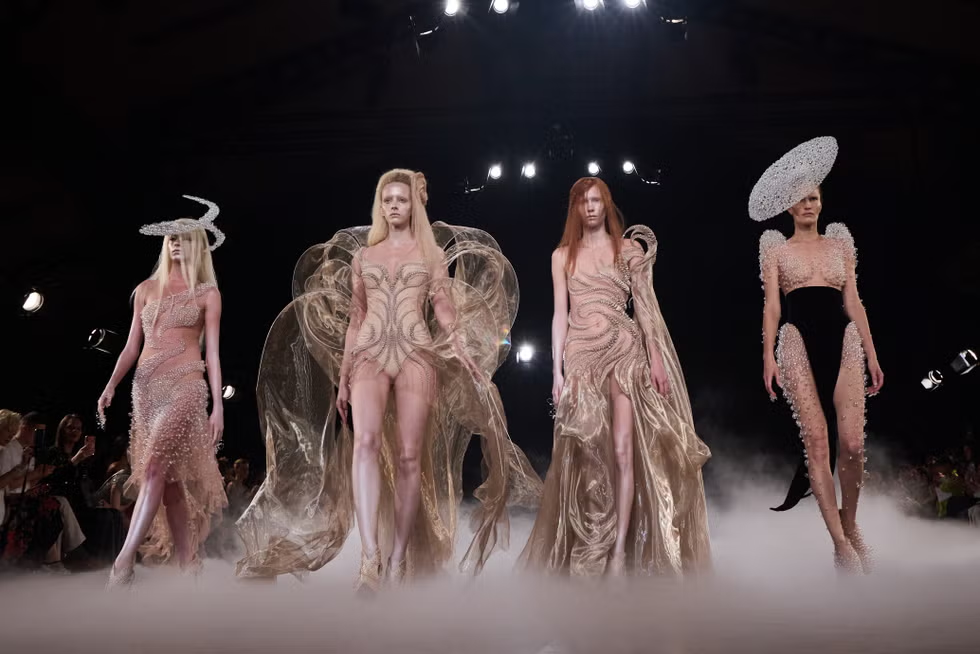
While many haute couture collections draw inspiration from art or history, Iris van Herpen continues to look toward science. For Fall/Winter 2026 Haute Couture, unveiled during Paris Haute Couture Week, the Dutch designer presented “Sonic Starquakes,” a collection inspired by stellar vibrations, plasma, galaxies, and the invisible forces that shape the universe.
The collection explores a fascinating scientific phenomenon known as starquakes—vibrations that ripple across a star’s surface much like earthquakes on Earth. Scientists have discovered that stars oscillate at measurable frequencies, effectively producing cosmic “music” as pressure waves travel through their plasma interiors. Blending astrophysics with couture craftsmanship, van Herpen translated these unseen rhythms into garments that feel less like clothing and more like living sculptures.
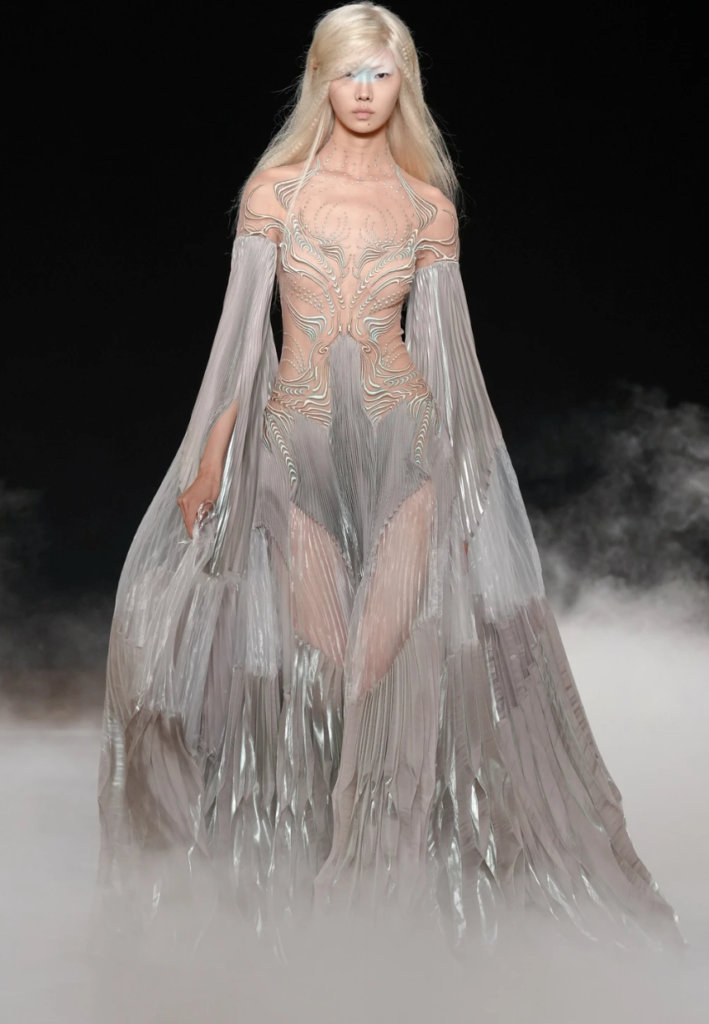
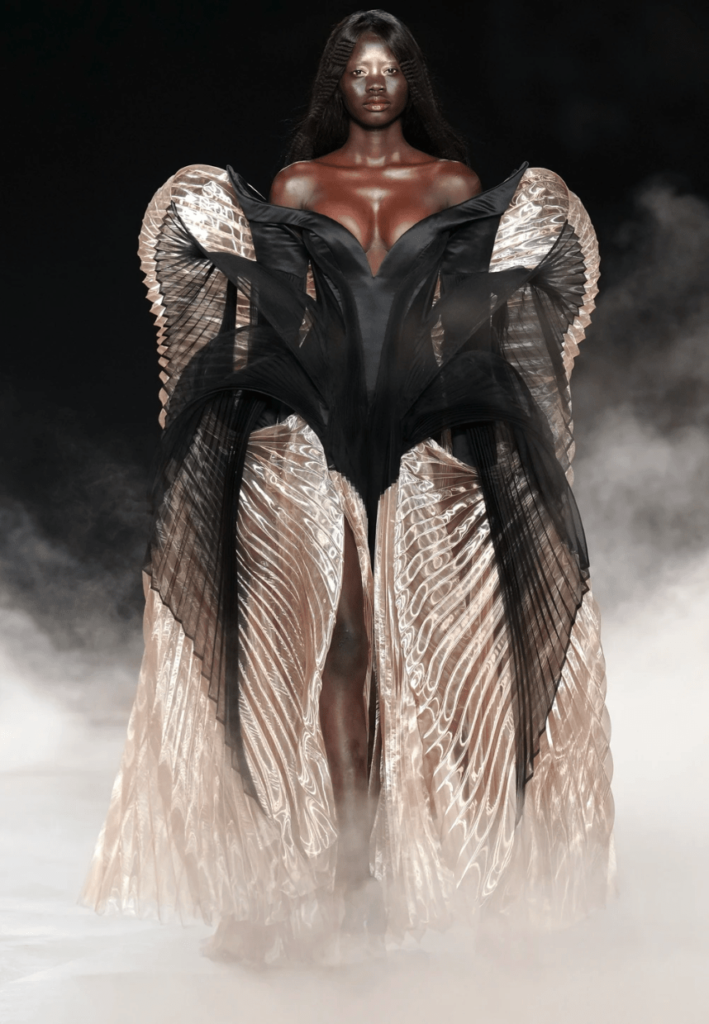
Iris van Herpen Fall/Winter 2026 Couture Collection
Plasma Enters Haute Couture for the First Time
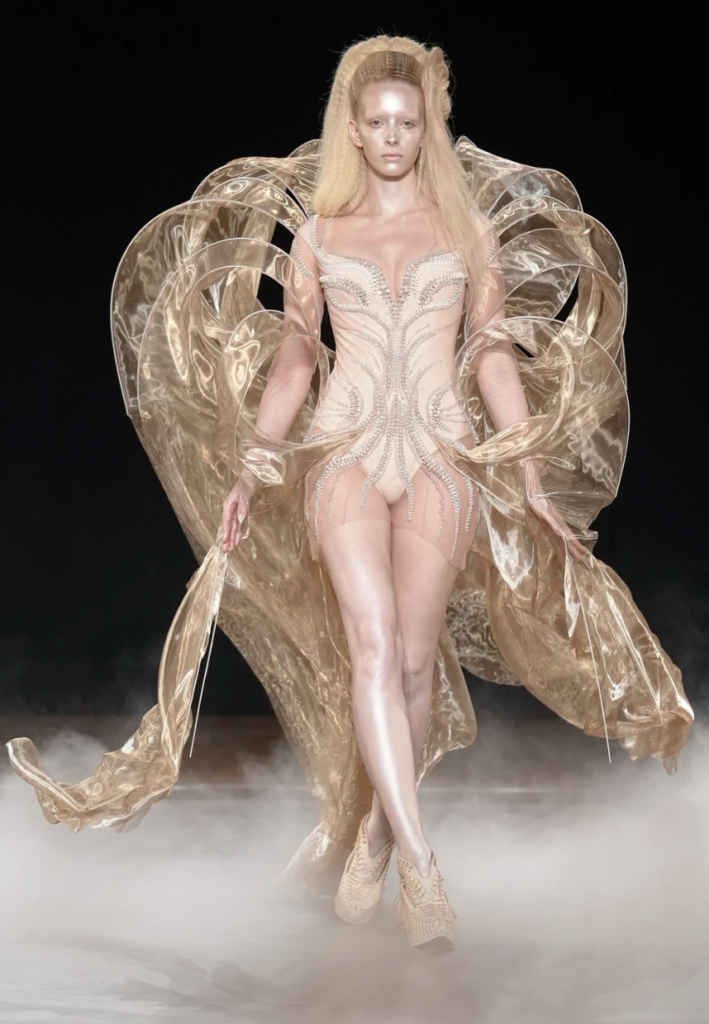
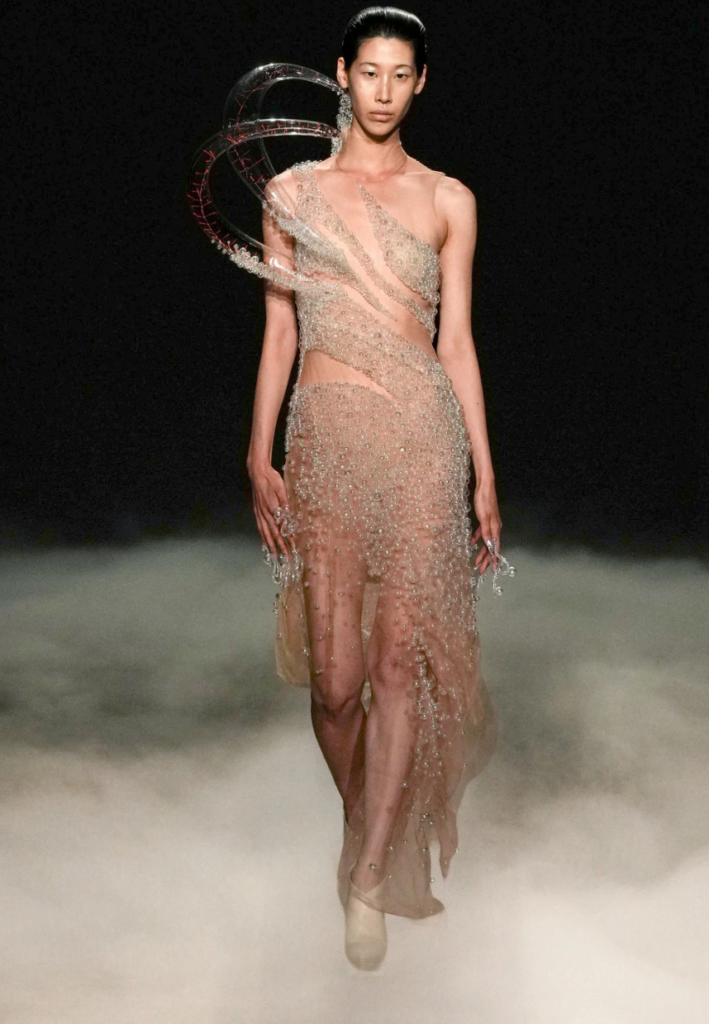
The collection’s most groundbreaking creation was undoubtedly the Helix Nebula gown, marking the first time plasma—the fourth state of matter—has been incorporated into haute couture.
Suspended from the shoulders were two crescent-shaped hand-blown glass chambers filled with glowing plasma. As the wearer moved or touched the garment, the plasma reacted to the body’s own electromagnetic field, creating an ever-changing display of light. Surrounding these luminous forms were more than 10,000 hand-blown glass spheres, meticulously attached to illusion tulle using ultraviolet technology. Across the entire collection, over 30,000 individually crafted glass spheres were used, highlighting the extraordinary craftsmanship behind every look.
The result was a dress that literally interacted with its wearer, momentarily merging the body’s electrical energy with one of the universe’s most abundant forms of matter. It was less a garment than a living experiment in wearable science.
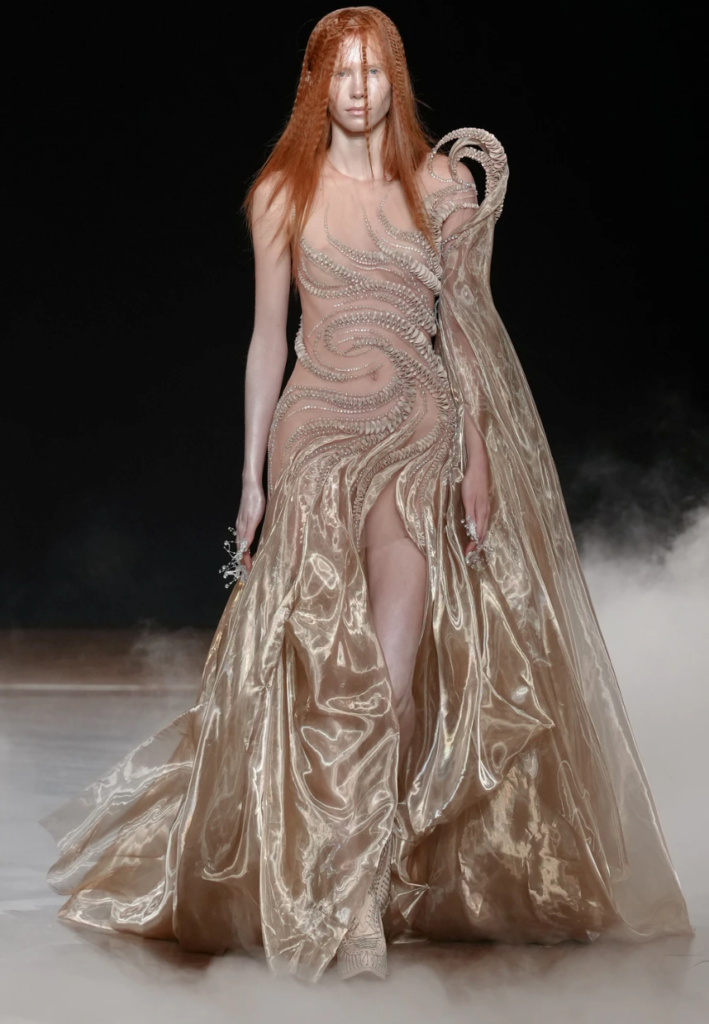
Iris van Herpen Fall/Winter 2026 Couture Collection
The Lightning Dress Was Finished by Nature Itself
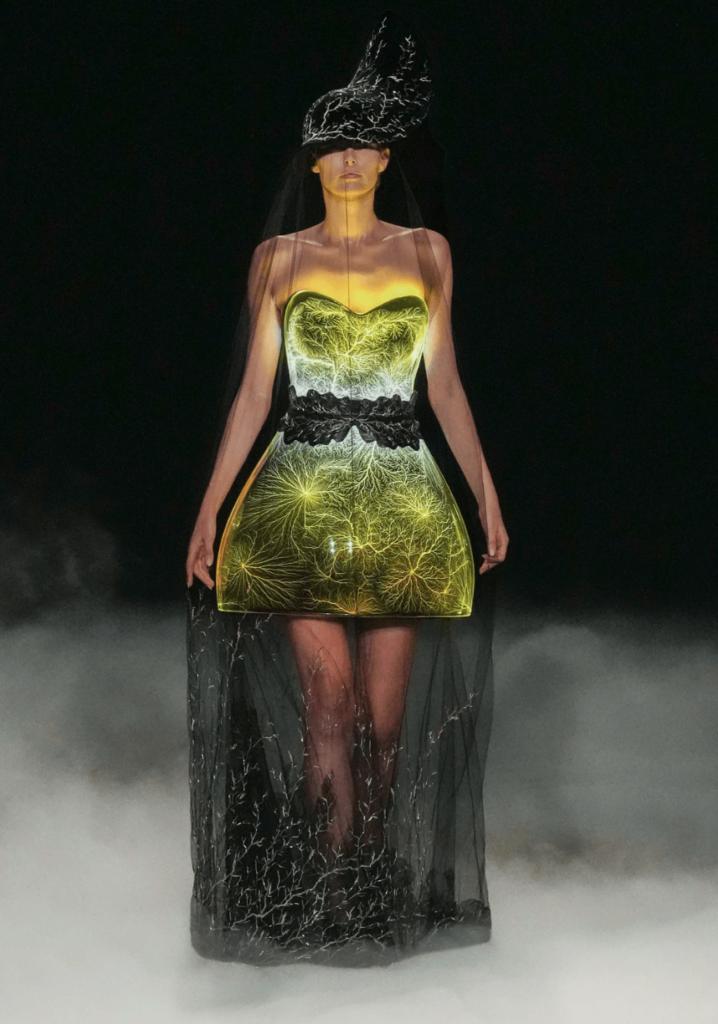
Equally astonishing was the Fractal Universe dress, a project that pushed couture beyond traditional craftsmanship and into experimental physics.
Constructed from transparent PMMA, the sculptural mini dress was placed inside a particle accelerator before being cryogenically preserved at temperatures approaching −100°C. The original intention was for the garment to discharge live electrical currents during the runway presentation, completing its design in real time.
Instead, something unexpected happened. In the days before the show, billions of trapped electrons escaped on their own, carving intricate branching patterns—known as Lichtenberg figures—across the surface of the dress. Rather than viewing the phenomenon as a mistake, van Herpen embraced it as the collection’s defining moment.
The final appearance of the garment was determined not by the designer’s hand, but by the same natural forces that shape lightning, river systems, tree roots, and even the human circulatory network. In doing so, the dress challenged one of fashion’s oldest assumptions: that every element of couture must remain under human control.
Iris van Herpen Fall/Winter 2026 Couture Collection
Where Fashion Meets Astrophysics
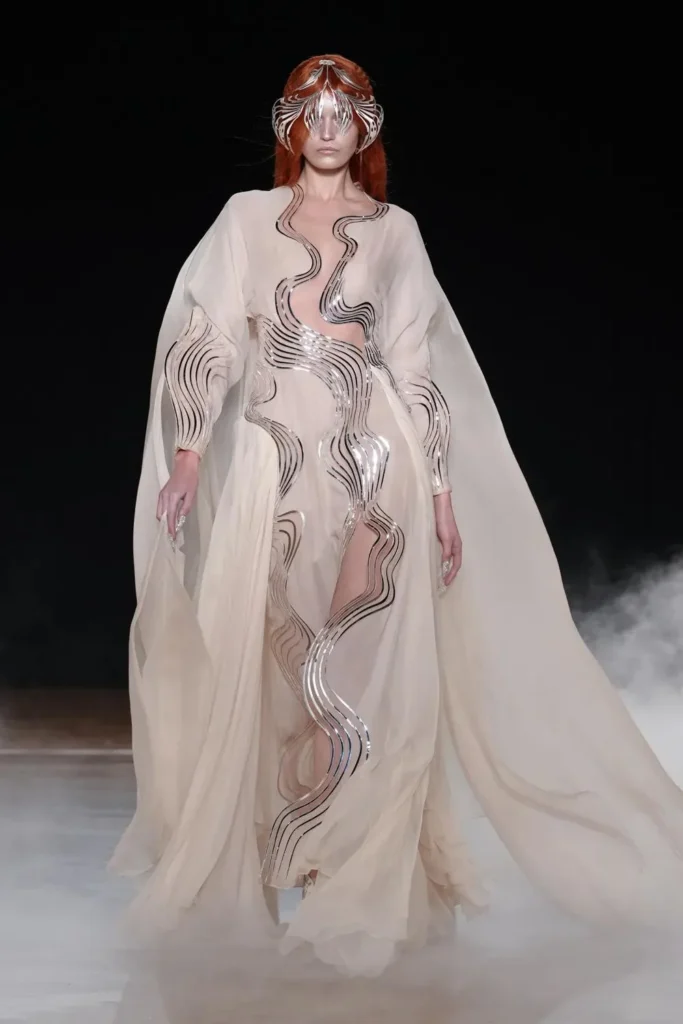
Scientific research forms the backbone of Sonic Starquakes. Van Herpen drew inspiration not only from astronomy but also from nineteenth-century inventor Margaret Watts Hughes, whose experimental instrument, the Eidophone, transformed vocal vibrations into intricate visual patterns.
Separated by more than a century, Hughes’s experiments and modern astrophysics share a common idea—that invisible vibrations can create extraordinary forms. Van Herpen uses this concept to suggest that the forces moving through our bodies are fundamentally connected to those shaping the stars.
Throughout the collection, branching embroidery echoed exploding supernovae, swirling silhouettes mirrored spiral galaxies, and flowing fabrics recreated the turbulence of plasma drifting through space. Rather than decorating garments with celestial motifs, she translated scientific principles into couture construction.
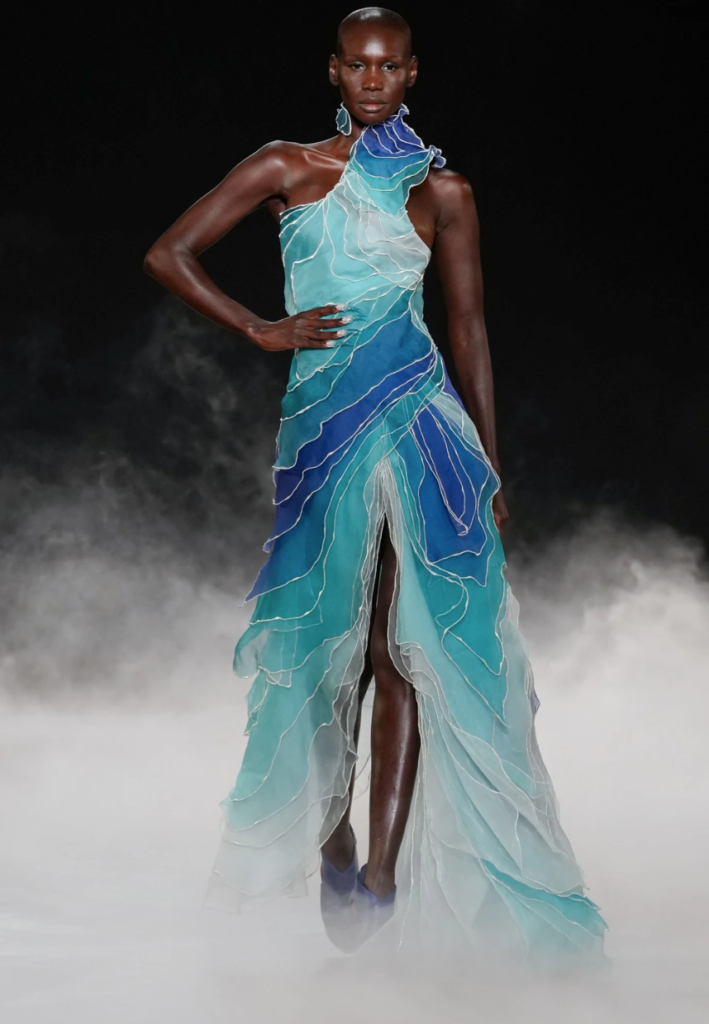
Iris van Herpen Fall/Winter 2026 Couture Collection
Signature Craftsmanship Elevated Through Innovation
Although the collection introduced revolutionary materials, it remained unmistakably Iris van Herpen.
Her signature floating silhouettes returned in Japanese “air” fabrics suspended on hidden wire structures, while printed silks, metallic chiffons, and translucent layers created garments that appeared to hover around the body. Bubble dresses—first introduced to widespread audiences when Eileen Gu wore one to the Met Gala—continued to evolve through increasingly intricate glasswork and sculptural volume.
Unlike many couture houses that emphasize embellishment, van Herpen focuses on engineering. Every material, technique, and silhouette serves as part of a larger investigation into movement, gravity, energy, and the relationship between the human body and the natural world.
Couture That Expands Our Understanding of Nature
For van Herpen, Sonic Starquakes is about much more than technological innovation. It is an invitation to reconsider humanity’s place within a much larger universe.
As she explained, the more science reveals about the cosmos, the more we realize how much remains unknown. Rather than attempting to explain these mysteries, the collection gives physical form to invisible forces that surround us every day—from lightning and plasma to electromagnetic fields and stellar vibrations.
This perspective has long distinguished van Herpen from her contemporaries. While many designers increasingly look to nature for inspiration, she moves beyond aesthetics, collaborating with scientists and engineers to transform scientific discovery into couture itself.